Recently, Professor Gao Shan, who serves as a jointly appointed professor at AI-HSS and the School of Foreign Languages of UESTC, and her team have released their latest research. This study is the first to reveal how foreign language contexts influence reactive aggressive behavior in bilingual individuals when they face provocation. The relevant findings, titled “Native and Foreign Language Contexts Differentiate Reactive Aggression,” have been published in the international journal Journal of Multilingual and Multicultural Development (Impact Factor: 3.9, CAS Zone 1).

Experimental Task | Image Source: Figure 1 of the Paper
This study is the first to examine the impact of language contexts on reactive aggressive behavior. The results show that participants exhibited a moderate level of aggression, and they were more inclined to pursue and protect gains rather than engage in costly aggressive behavior. This behavioral pattern was weakened in foreign language contexts. Specifically, in the foreign language (English) context, participants pressed the “aggressive button (which deducts points)” significantly more frequently than in the native language (Chinese) context. This increase in aggressive behavior is likely because foreign language contexts reduce the restrictive effect of social norms on behavior. Compared with using one’s native language, using a foreign language may evoke fewer memories related to prohibitions or social constraints, making it easier for individuals to break through normative limits. In addition, the “point-deduction aggression paradigm” adopted in this study requires participants to pay a cost for aggressive behavior – that is, losing the opportunity to increase their points. Therefore, there may be another reason behind the study’s results: compared with the native language context, foreign language contexts weaken the negative emotions triggered by the costs of aggressive behavior, thereby leading to an increase in retaliatory behavior that requires paying a cost. These two explanations are not mutually exclusive but complementary. Together, they confirm a widely discussed hypothesis in academic circles: compared with one’s native language, a foreign language changes human cognition and behavior by increasing psychological distance and weakening emotional resonance.
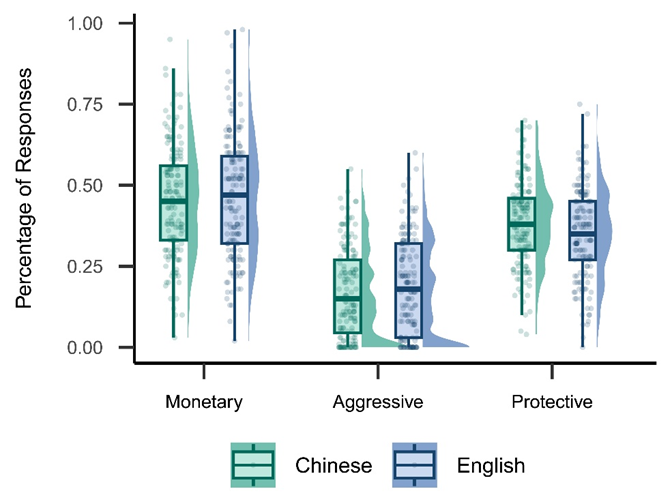
Experimental Results | Image Source: Figure 2 of the Paper
The findings of this study can provide important insights for promoting safe and friendly social interactions in multilingual environments, such as international negotiations and daily online communication.
Link of the paper:
https://www.tandfonline.com/eprint/JDZHEN2TBGY5E5CJH7IY/full?target=10.1080/01434632.2025.2569561