
The International Genetically Engineered Machine (iGEM) competition is an annual top-tier synthetic biology event initiated by MIT and organized by the iGEM Foundation. The 2025 iGEM Grand Jamboree was held in Paris, France. As the largest and most widely participated international event in the global synthetic biology field, it includes activities such as the iGEM Competition and the iGEM Responsibility Conference.
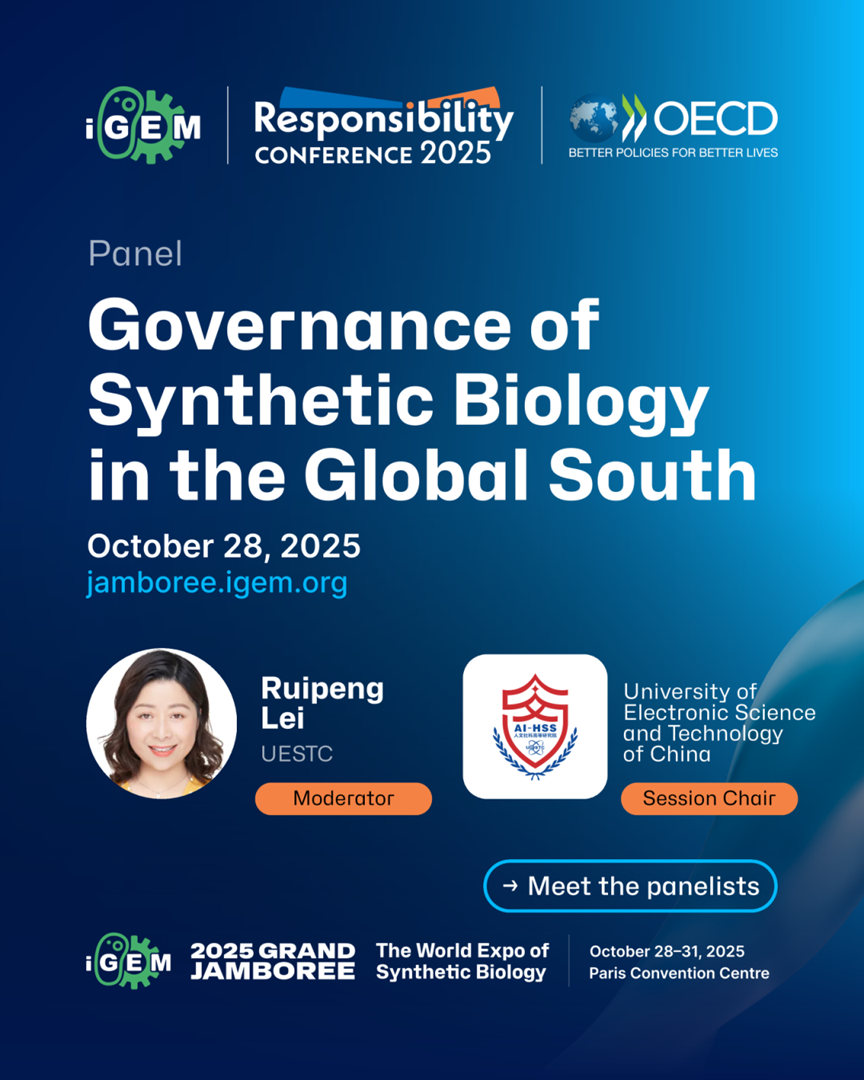
Invited by the iGEM Organizing Committee, Professor Lei Ruipeng, Vice Dean of AI-HSS, participated in the conference as the first Chinese expert to serve as a moderator at the iGEM Responsibility Conference. The 2025 iGEM Responsibility Conference consisted of six thematic sessions. Professor Lei, as the moderator of “Governance of Synthetic Biology in the Global South” session, discussed key topics such as “global governance collaboration” and “ethical norms and responsible practices”. Centering on the perspective of the Global South, this session challenged the existing governance paradigm and explored “Global Solidarity” as a normative principle and practical framework for inclusive synthetic biology governance. It examined how the current governance structure inadvertently excludes or marginalizes the voices of the Global South and explored paths to achieve more equitable participation in jointly shaping the future of technology.
The session invited researchers from four countries—Australia (Sonja Van Wichelen), Brazil (Marilene Pavan), the United States (Luis Campos), and India (Krishna Ravi Srinivas)—to discuss together. Among them, Luis Campos from the United States was one of the conveners of the 50th Anniversary Summit of the Asilomar Conference held in San Francisco this year. During the session, participants not only discussed the definition of “Global Solidarity” reflecting the perspective of the Global South and theoretically explored current governance gaps and their impacts on stakeholders in the Global South, but also worked with experts from various countries to develop actionable institutional mechanism proposals to implement the principle of solidarity, build a network of Global South institutions for collaborative governance, and provide executable suggestions for international organizations and the iGEM community.