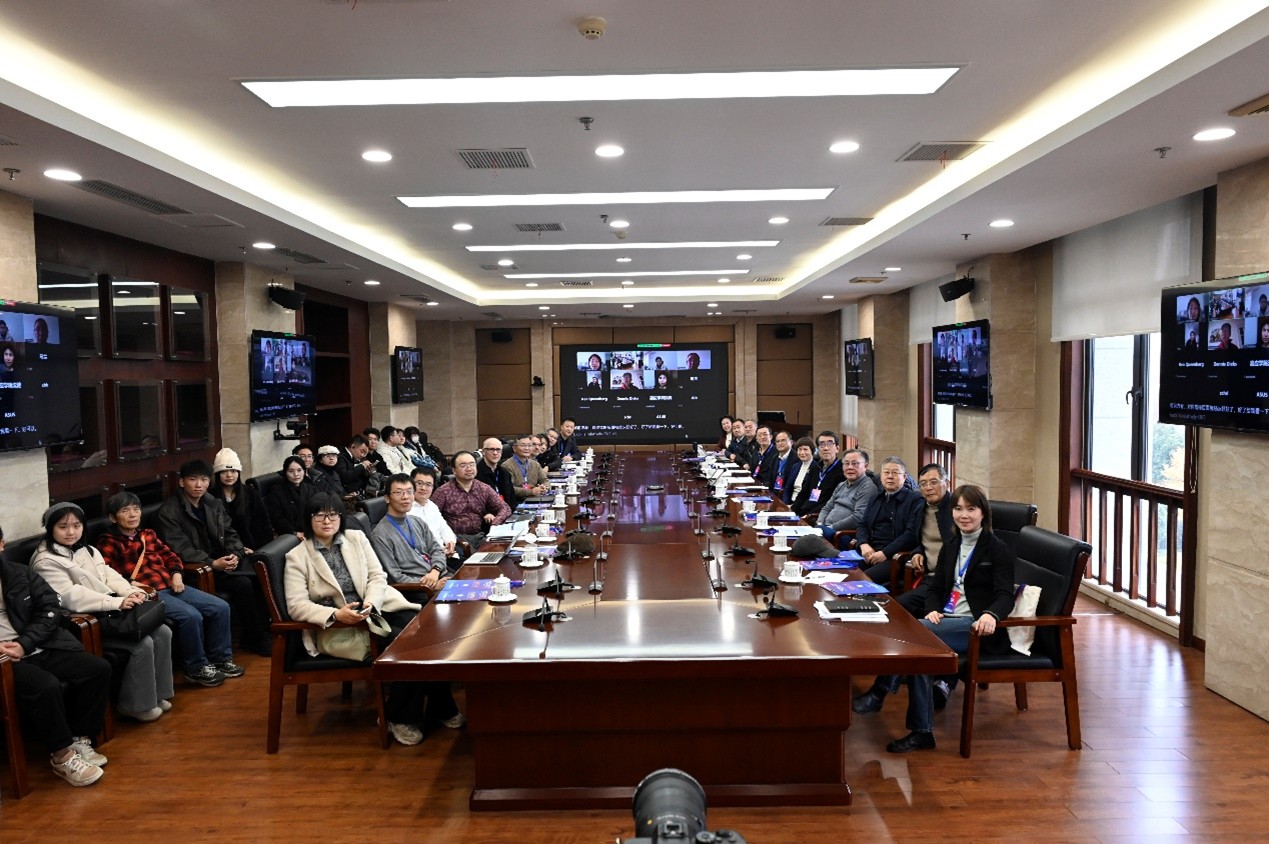
From December 13th to 14th, the Symposium on "Philosophy of Quantum Physics, Philosophy of Artificial Intelligence and Logical Permeationism" was held in a hybrid format at the Qingshuihe Campus. Cao Ping, Secretary of the University Council, Wu Xiaoqiu, Honorary Dean of AI-HSS and former Vice President of Renmin University of China, Liu Chuang, President of the Asian Philosophy of Science Association and Academic Director of the Institute of Philosophy, Chinese Academy of Sciences, and Wu Guolin, Director of the Physics Philosophy Professional Committee of the Chinese Society for Dialectics of Nature, attended the opening ceremony and delivered speeches. Zeng Yong, former UESTC President and Dean of AI-HSS, was present. The opening ceremony was presided over by Shen Xiaorong, Executive Director of the AI-HSS Academic Council.
Cao Ping stated that UESTC attaches great importance to the in-depth integration of science and technology education with humanities education, and established AI-HSS in December 2024, with the ethics and philosophy of science and technology being one of the four research directions of the institute. Currently, emerging technologies represented by quantum technology and artificial intelligence are having significant and far-reaching impacts on human production and lifestyle. It is essential to pay attention to the discussion and research on these emerging technologies, their ideological roots, logical foundations, and ethical governance. This conference will provide a platform for experts and scholars to exchange research progress and spark intellectual collisions, jointly contributing wisdom and strength to the advancement of research in this field.
Wu Xiaoqiu stated that for the "15th Five-Year Plan" and even a longer period in the future, it is essential to have original scientific ideas to better lead social progress and economic development. A relatively tolerant environment, an equal communication mechanism, and a scientific and reasonable incentive system should be created for innovation. He hopes that all scholars will conduct in-depth discussions around the conference theme and contribute more insightful views.
Liu Chuang stated that the establishment of AI-HSS at UESTC, which brings together relevant scholars to conduct interdisciplinary research, is of great significance. He introduced the paper collection situation of the symposium, thanked the teachers and students of the Institute for their efforts in holding the conference, and hoped that the conference would be a complete success and achieve fruitful results.
Wu Guolin introduced the basic situation of the professional committee, stating that important scholars from multiple countries gathered at this conference to conduct in-depth philosophical thinking and dialogue exchanges around the important frontier issues of quantum mechanics, artificial intelligence and logic, which is conducive to better dispelling the mystery of quantum mechanics and exploring the potential of artificial intelligence.
During the symposium, keynote speeches and several invited talks as well as online special sessions were held. Scholars from universities and research institutions such as the University of Cambridge, the University of California, Berkeley, Fudan University, Shanghai Jiao Tong University, Wuhan University, Beijing Normal University, and the University of Chinese Academy of Sciences engaged in in-depth exchanges on topics including commemorating Professor Yang Zhenning's contributions and thoughts in physics, fundamental and philosophical issues in quantum physics, the foundations, frontiers, and philosophical problems of quantum information, intelligence, and life science and technology, and logical penetrationism.
This symposium was co-hosted by UESTC and the Physical Philosophy Professional Committee of the Chinese Society for Dialectics of Nature, Science and Technology, and was co-organized by AI-HSS and the research group on the philosophy and logic of quantum information science and technology.