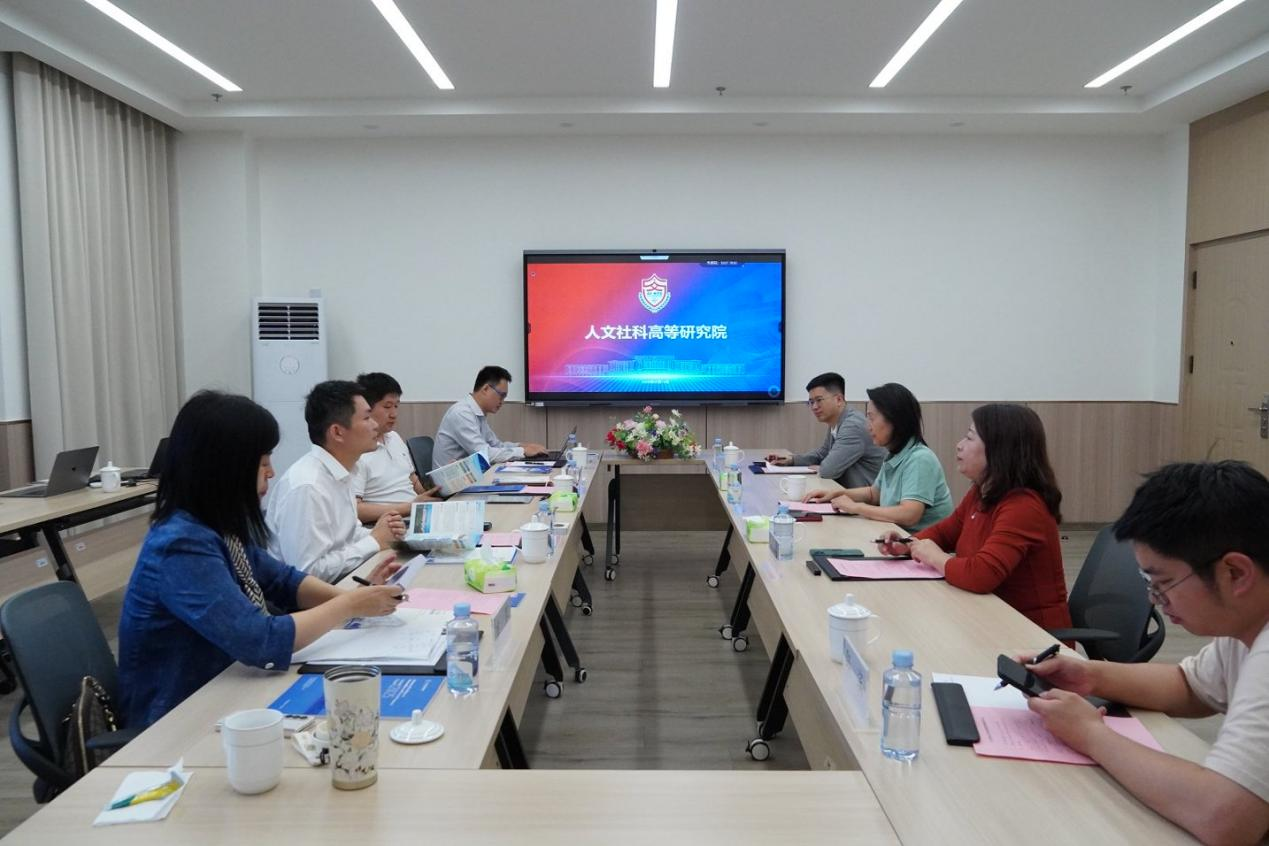
On May 14, Li Weiwei, Deputy Director of the Science Supervision and Integrity Construction Division of Shenzhen Science and Technology Innovation Bureau, and his delegation visited AI-HSS for a symposium on the governance of science and technology ethics. Relevant leaders and faculty representatives of AI-HSS attended the discussion.
Shen Xiaorong, Executive Director of the Institute Affairs Committee of AI-HSS, extended a warm welcome to the guests and introduced the founding mission of AI-HSS and the development of its science and technology ethics degree programs. Li introduced Shenzhen’s explorations and practices in the supervision of science and technology ethics and the construction of a regional ethics service platform. He noted that as a highland for scientific and technological innovation, Shenzhen attaches great importance to the governance of science and technology ethics, and hopes to learn from the experience of UESTC in this field to jointly explore effective paths for “Tech for Good”.
Ji Ping, Deputy Director of the Clinical Research Institute of the Peking University-Hong Kong University of Science and Technology Medical Center in Shenzhen and Chairperson of Shenzhen Biomedical Ethics Review Committee, and Fang Zhengyu, Director of the Office of Shenzhen Regional Science and Technology Ethics Service Platform, introduced the team building, talent introduction and project cooperation of Shenzhen’s regional science and technology ethics platform, and expressed their expectation for in-depth cooperation with AI-HSS to jointly explore effective governance mechanisms for ethics in emerging technologies such as artificial intelligence and biomedical technology.
Lei Ruipeng, Vice Dean of AI-HSS, outlined the institute’s progress in talent training, faculty strength, and international exchanges and cooperation in the governance of science and technology ethics. She elaborated on the university’s ethical review standards, interdisciplinary collaboration models, and risk prevention practices in emerging technology fields including artificial intelligence, quantum technology and biomedical technology, as well as the structure, operation and supervision standards, working mechanisms of the Science and Technology Ethics Committee, the construction of the science and technology ethics curriculum system and regular education content.
The two sides also exchanged views on future cooperation, reaching a preliminary consensus on sci-tech ethics training, co-construction of regional service platforms, and joint talent training. They agreed to establish a regular exchange mechanism to jointly improve the governance system of science and technology ethics and promote the sound development of technology.