Keynote Speaker
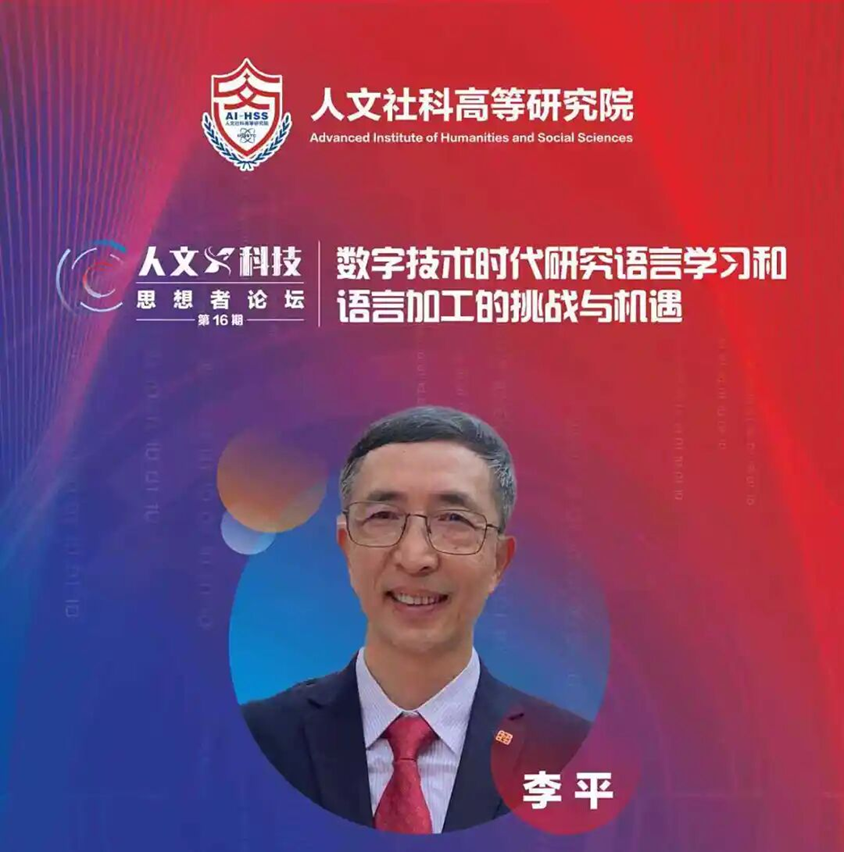
Li Ping is the Simon Suen Fund Professor of Humanities and Science, Chair Professor of Neurolinguistics and Bilingualism in the Department of Chinese and Bilingual Studies at The Hong Kong Polytechnic University (PolyU). He also serves as Dean of the Faculty of Humanities and Vice President of PolyU Hangzhou Institute for Innovation and Technology. Previously, he was a tenured professor in Psychology, Linguistics, and Information Sciences and Technology at Pennsylvania State University, USA, President of the Society for Mathematical Psychology, and Program Director of Cognitive Neuroscience at the US National Science Foundation. Currently, he is Editor-in-Chief of Brain and Language and Senior Editor of Cognitive Science. Professor Li was elected a Fellow of the American Association for the Advancement of Science in 2021 and a Fellow of the Cognitive Science Society in 2024. His research focuses on language acquisition, bilingualism, and reading comprehension. He fully utilizes cognitive neuroscience and computational modeling methods to study the relationship between language and the brain and its technological applications. He has published numerous research monographs and over 200 academic papers in journals such as PNAS, Science Advances, Nature Human Behavior, and Nature Computational Science. For more information about Professor Li and his team's research, please visit https://blclab.org/.
Main Content
In the era of rapid development of digital technology and generative artificial intelligence, we need a comprehensive, interdisciplinary perspective to understand the mechanisms of language learning and representation. Combining emerging technologies, AI-driven models, and current computational neural theory methods, we explore how language learning and knowledge representation operate in the human brain. We emphasize the social interaction mechanisms and computational processes of language learning. In-depth exploration of these mechanisms and processes allows us to understand the differences between language learning in children and adults, as well as individual differences among normally developing adults in different learning environments. Based on this, we further compare the similarities and differences between AI models and human learners, and how the latter effectively integrate multimodal information in social interaction environments. Collecting and analyzing real-time multimodal data will greatly enhance our understanding of the neural mechanisms of language learning and help develop evidence-based, personalized learning tools. Research on language learning and its cognitive neural mechanisms in the digital technology era faces multiple challenges. Researchers and educators need to integrate diverse interdisciplinary theories and methods.
Time
November 3, 2025 (Monday), 16:00
Location
Coffee Beanery
Sign-up QR Code

Organizer
Advanced Institute of Humanities and Social Sciences (AI-HSS)