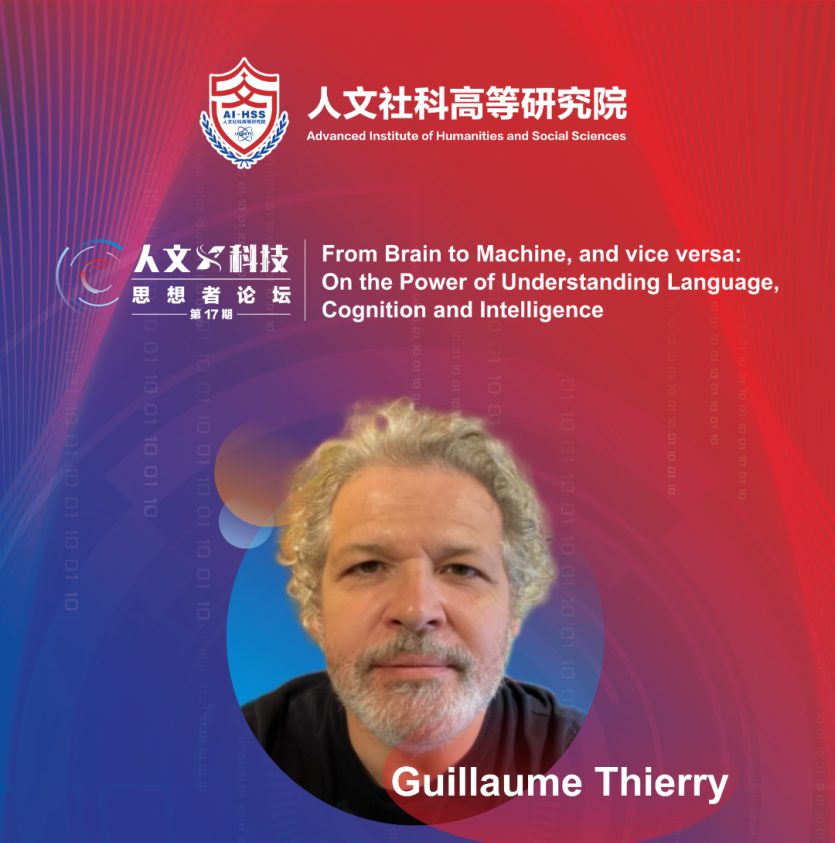
Keynote Speaker
Professor Guillaume Thierry studies the processing of meaning by the human brain and interactions between language and other cognitive processes such as attention, memory, emotion, and decision-making. He has received funding from UK Research Councils, the European Research Council, the British Academy, and, more recently, the Polish Academic Exchange Program to investigate the integration of meaning in infants and adults at lexical, syntactic, and conceptual levels.
Main Content
This talk introduces language cognition and intelligence as a bridge between neuroscience and engineering. It shows how the human brain processes language as a structured signal through predictive, computational, and optimization mechanisms that modern AI is trying to mimic. I will present evidence from EEG and ERP studies that reveal how meaning, emotion, and multilingual activation emerge in milliseconds— mostly outside conscious awareness. These findings demonstrate that language understanding is dynamic, not static. I will also show how such mechanisms can be connected to engineering principles—signal processing, error minimization, adaptive learning—and explain how they inspire models like transformers and predictive coding systems. I will highlight applications in domains such as brain–computer interfaces, emotion-adaptive AI, and explainable machine learning but also some of the risks attached to these approaches. Understanding the brain’s language system is a high-leverage path toward more “intelligent”, usable AI: decoding how brains compute meaning informs how machines may too.
Time
November 6, 2025 (Thursday), 14:00
Location
Coffee Beanery
Sign-up QR Code

Organizer
Advanced Institute of Humanities and Social Sciences (AI-HSS)