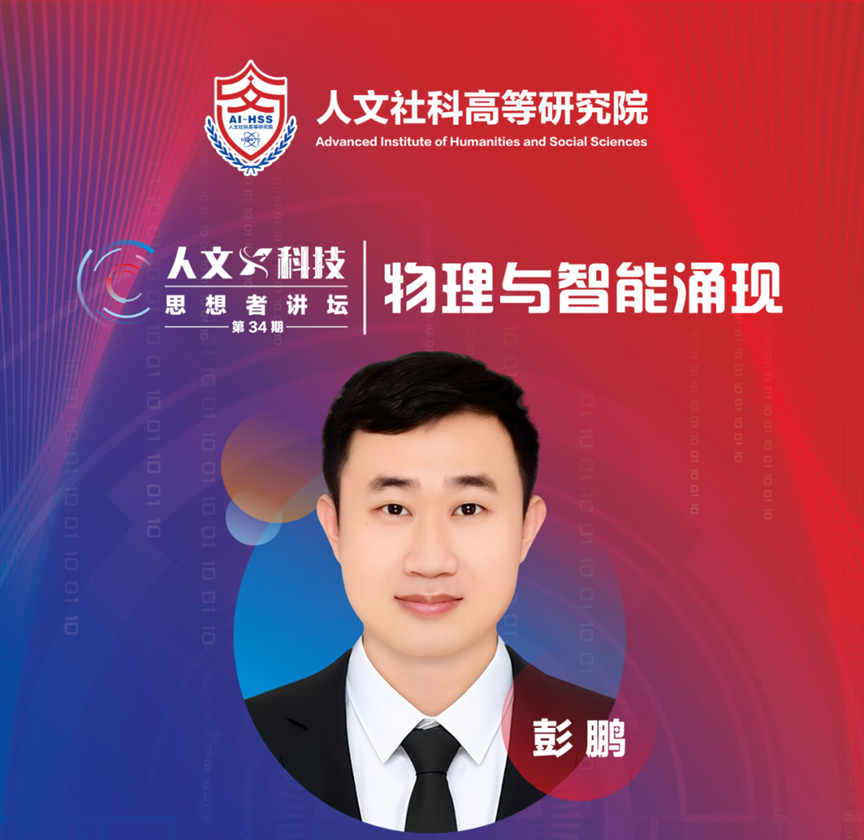
Keynote Speaker:
Peng Peng, Associate Professor, Doctoral Supervisor and Deputy Director of the Institute for the History of Science and Technology at Shanxi University, holds a PhD in Science. He has been recognized as the Top Young Talent of the "Three Jin Talents" Program, a Wenying Young Scholar of Shanxi University, and a Visiting Scholar at Renmin University of China. He also serves as Deputy Secretary-General of the Physics History Committee under the Chinese Society for the History of Science and Technology, Executive Council Member of the Precision Science History Committee under the same society, Director of the Philosophy of Physics Committee of the Chinese Society for Dialectics of Nature, and Member of the Technology Foresight Committee of the Chinese Association of Science of Science and Science & Technology Policy Research. He joined the Institute for the History of Science and Technology at Shanxi University in August 2018. His main research interests cover the history of physics, quantum optics, science and technology policy, and philosophy of science and technology. As the first author, he has published papers in top international journals including Physical Review. Three of his papers have been fully reproduced in full in Xinhua Digest. He has won three provincial and ministerial-level government awards for humanities and social sciences, and presided over three national interdisciplinary research projects integrating arts and sciences.
Main Content:
Since its first awarding in 1901, the Nobel Prize in Physics has honored scientists who have made outstanding contributions to fundamental physics, experimental physics, applied physics and related fields. Notably, the 2024 Nobel Prize in Physics set a historic precedent: for the first time, it was awarded to two scientists for their groundbreaking achievements in artificial intelligence, namely John J. Hopfield from Princeton University in the United States and Geoffrey Hinton from the University of Toronto in Canada. Philip Anderson, a condensed matter physicist and laureate of the 1977 Nobel Prize in Physics, put forward the famous thesis “More is different”, which challenged reductionism. He argued that when particles aggregate into a many-body system, entirely new properties emerge that bear no relation to the characteristics of individual particles. In the research of Hinton, Anderson and other scholars, the emergence of intelligence rooted in physics stands as a core concept yet to be fully unified and comprehended.
Time: June 25, 2026 (Thu), 16:30
Location: Coffee Beanery
Organizer: Advanced Institute of Humanities and Social Sciences (AI-HSS)