On December 19th, AI-HSS successfully held the 22nd “Humanities × Technology” Thinkers’ Forum. With the theme “Possible Paths for Moral Enhancement of AI”, the forum invited Professor Wang Guoyu as the keynote speaker. Professor Wang is a Member of the Chinese Academy of Medical Sciences, a Member of the National Science and Technology Ethics Committee, and a Level-2 Professor at the School of Philosophy, Fudan University. The forum was moderated by Professor Lei Ruipeng, Vice Dean of AI-HSS.
Professor Lei introduced Professor Wang’s profound attainments and fruitful achievements in fields such as science and technology ethics and bioethics. She also pointed out the core value of this forum, which focuses on the intersection of AI and ethics, kicking off the on-site exchanges.
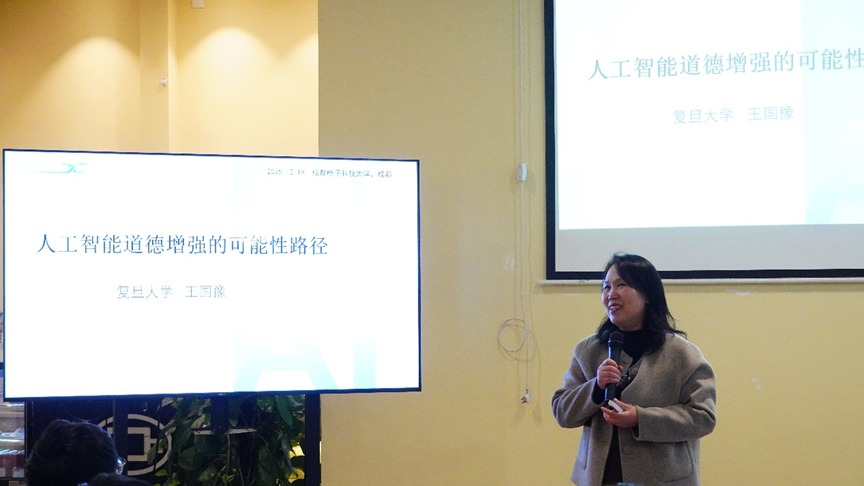
Professor Wang delivered a systematic presentation centered on “moral enhancement of AI”, sorting out three types of moral enhancement paths and their associated problems: biotechnology, VR technology, and AI. Biotechnology improves moral character through nanomedicine, gene editing, etc., but faces controversies such as infringement of free will. VR technology enhances moral agency via immersive experiences, yet carries risks of mind control and difficulty in translating into real actions. AI can assist in moral decision-making, divided into three categories: decision substitution, moral consulting, and Socratic dialogue. While it has application potential, it raises concerns about human decision-making power and algorithm opacity. Professor Wang emphasized that the core of AI moral enhancement is to assist humans in improving decision-making capabilities, not to replace or control us, laying the groundwork for subsequent interactive discussions.
In the Q&A session, teachers and students on-site discussed topics including the relationship between traditional ethics and moral enhancement technologies, resolving ethical conflicts in AI moral decision-making, ethical issues of AI products, responsibility attribution, and moral standards. Professor Wang responded to each question, clarified the essential differences between AI moral enhancement and biotechnological enhancement, and pointed out that ethical conflicts need to be resolved through value-sensitive design. She also stressed that algorithms should be regulated and enterprises must fulfill ethical responsibilities, and reaffirmed that humans must retain the final decision-making power when using AI.

This forum combines theoretical depth with practical value. It deepened the on-site teachers’ and students’ understanding of balancing technology and ethics, provided important insights for academic research and practical exploration in the field of science and technology ethics, and injected humanistic thinking into promoting the healthy and orderly development of AI.