On December 12th, Professor Chen Bo, a Ph.D. in Philosophy from Renmin University of China, a recipient of the Special Government Allowance from the State Council, and a professor at the School of Philosophy, Wuhan University, was invited to AI-HSS. He delivered an academic lecture titled "Why We 'Must' and 'Should'—Bridging the Gap Between 'Is' and 'Ought'," with Professor Wan Xiaolong serving as the host.
At the beginning of the forum, Professor Wan Xiaolong extended a warm welcome and sincere gratitude to Professor Chen Bo, briefly introducing his main research areas and achievements. Professor Chen Bo specializes in logic and analytical philosophy, has led major projects funded by the National Social Science Fund, as well as several projects supported by the Ministry of Education and Beijing municipal funds, demonstrating profound academic expertise. During the lecture, Professor Chen refuted the view proposed by Hume, Moore, and others regarding the division and gap between "is" and "ought," "facts" and "values," and "norms." He argued that this division is, in fact, fictional—there is no purely objective "fact," as facts inevitably involve the subjective engagement of the cognitive subject; nor is there a purely subjective "norm," as norms must be supported by objective foundations and theoretical grounds. Regarding why people make judgments of "must" and "should," Professor Chen provided answers from four dimensions: the factual level, the motivational level, the knowledge level, and the capability level. These factors intertwine, closely linking "is" and "ought" and bridging the gap between "facts" and "values" or "norms."
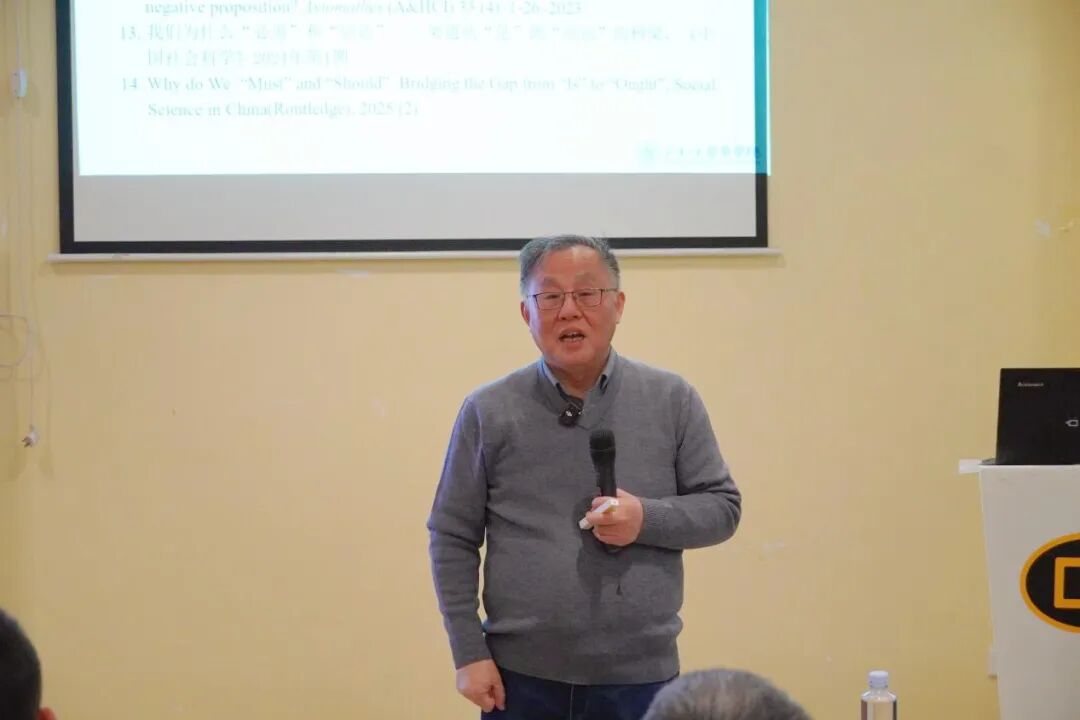
Subsequently, Professor Chen introduced Dewey's pragmatism and an evolutionary perspective, pointing out that organisms interact with their environment due to survival needs. Human consciousness is an extension of biological adaptation, and human actions to transform the world are essentially for the survival and development of individuals, communities, and humanity as a whole. Using the "universal hypothetical imperative" as an example, he emphasized that, based on human sociality and rational thinking abilities, social communities evolve shared needs and develop collective intentionality. Members of society must balance self and others to universalize norms, thereby maintaining social harmony and stability.
During the Q&A session, the audience raised questions about the binary logic of "is and is not," the narrative nature of facts, and the relationship between facts and normative claims. Professor Chen responded by stating that facts carry both subjective imprints and objective components, while normative claims are constructed on objective elements such as needs, social consensus, and reality gaps, deepening the discussion on the relationship between facts and value norms.
This lecture integrated academic origins, core theories, real-world cases, and Western philosophical thought, providing profound academic perspectives and directions for reflection. It offered students and faculty a high-level platform for face-to-face dialogue with leading scholars and sparked enthusiastic discussions among attendees.