On January 9, 2026, AI-HSS hosted the 25th “Humanities × Technology” Thinkers’ Forum. The forum, themed “The Design of Microeconomic Mechanisms: An Introduction”, invited Professor Hervé Moulin from the Adam Smith Business School at the University of Glasgow—former President of the Game Theory Society, Fellow of the Econometric Society, Fellow of the British Academy, and Fellow of the Royal Society of Edinburgh—as the keynote speaker. The forum was moderated by Associate Professor Hao Dong from AI-HSS and the School of Computer Science at UESTC.
During the lecture, Professor Moulin systematically addressed the core topics of mechanism design. In the section on fundamental concepts, he clarified that its core objectives include efficiency, fairness, and incentive compatibility. The underlying logic involves designing scientific rules to guide individual self-interested behaviors toward collective optimal outcomes. Using the majority voting rule as an example, he vividly illustrated the path to unifying fairness and efficiency in scenarios with dual-candidate proposals.
During the practical application case study segment, Professor Moulin introduced the Split the Pie website, which specializes in fair distribution solutions and can effectively address real-world issues such as rent splitting among roommates and shared taxi fare calculations. He also provided an in-depth analysis of the application logic of the Shapley value in cost allocation, highlighting its specific methodology and fairness principles in shared travel expense calculations. To tackle conflicts of interest in peer evaluations, he proposed an optimized fair allocation scheme based on subjective assessments.
Regarding fair allocation and market competition equilibrium, Professor Moulin introduced the concept of “Competitive Equilibrium from Equal Incomes” and explored its practical value in allocating indivisible goods. He provided a detailed analysis of the mathematical properties and application advantages of this method in terms of uniqueness, ease of computation, and continuity.
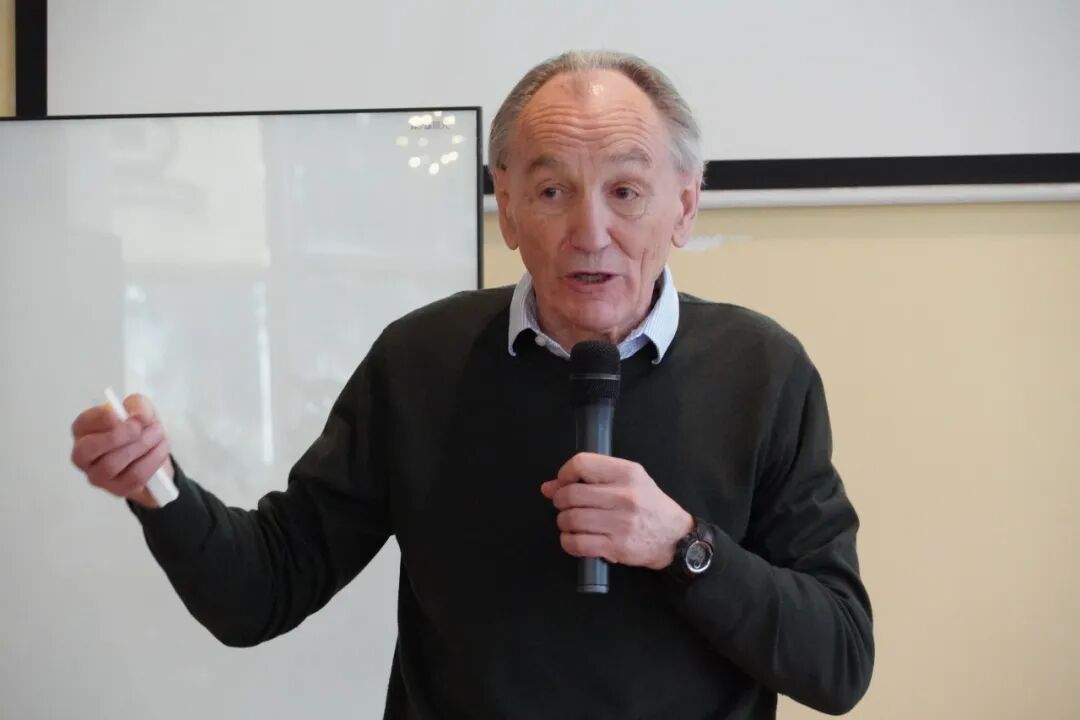
The Q&A session was lively, with faculty and students engaging in in-depth exchanges with Professor Moulin on several key issues: examining the premises of economic models and their transferability, and analyzing their applicability to scenarios such as government public investment games involving human physicists and AI for Science (AI4S); dissecting the central role of fairness and anonymity in mechanism design and the principles of adaptation across different contexts; envisioning the application prospects and potential challenges of mechanism design in financial markets; and exchanging perspectives on the impact of artificial intelligence on future society and the feasibility of Universal Basic Income as a fair allocation scheme.
This lecture focused on the core themes of mechanism design and fair allocation, deeply integrating economic theory with artificial intelligence application scenarios. It systematically demonstrated the interdisciplinary value of this field. Through explanations of cutting-edge theories and analyses of real-world cases, it not only provided academic inspiration for attendees but also offered scientific approaches and practical pathways for solving various resource allocation challenges, further promoting interdisciplinary integration and innovation between the humanities and social sciences and the field of technology.