On June 18, Professor Zhou Zhen from Tsinghua University paid a visit to the Advanced Institute of Humanities and Social Sciences (AI-HSS). Both sides held in-depth discussions on core agendas including the institute’s disciplinary development, faculty recruitment and cultivation, academic ecosystem construction and long-term future planning, with the institute’s administrative leaders and faculty representatives present at the forum.
Professor Zeng Yong, Dean of AI-HSS, extended a warm welcome to Professor Zhou on behalf of the institute and briefed him on its progress in development. Founded at the end of 2024, AI-HSS leverages the university’s strengths in electronic information disciplines and focuses on four interdisciplinary research streams: ethics and philosophy of science and technology, cognitive linguistics and language intelligence, mathematical and quantitative economics, as well as technological innovation and social transformation. Remarkable initial achievements have been made in the development of research teams, disciplinary layout and overseas academic cooperation.
Both sides focused their discussion on the challenges and countermeasures concerning faculty recruitment. At present, AI-HSS is still confronted with pressures in talent aggregation, institutional brand recognition and locational competition. Professor Zhou suggested gathering scholars, boosting academic exchanges and raising the institute’s academic visibility by hosting high-level academic conferences and launching a short-term visiting professorship program, alongside clarifying recruitment criteria to gradually build a sustainable academic ecosystem. He endorsed the institute’s interdisciplinary positioning and offered to provide support in organizing academic conferences and recommending overseas scholars.
On the same day, Professor Zhou delivered a special lecture titled Overcoming Coordination Failure: Theory and Policy as the guest speaker of the 32nd “Humanities × Technology” Thinkers’ Forum.
Starting from the core “Coordination Problem” in game theory, Professor Zhou illustrated the formative logic of coordination failure, pointing out that this phenomenon widely prevails in fields such as artificial intelligence research and development, platform economy and finance. Drawing on real-world cases including the Silicon Valley Bank run and corporate credit withdrawal, he interpreted the predicament that markets tend to fall into inefficient equilibria, systematically introduced two solutions to mitigate such failures, payoff subsidies and information intervention, and shared cutting-edge research on dynamic coordination and government subsidies. Two of his original findings carry high reference value: hierarchical social networks with opinion leaders facilitate collective action more readily, and industrial subsidies yield optimal effects only when allocated within the critical range of private investment.
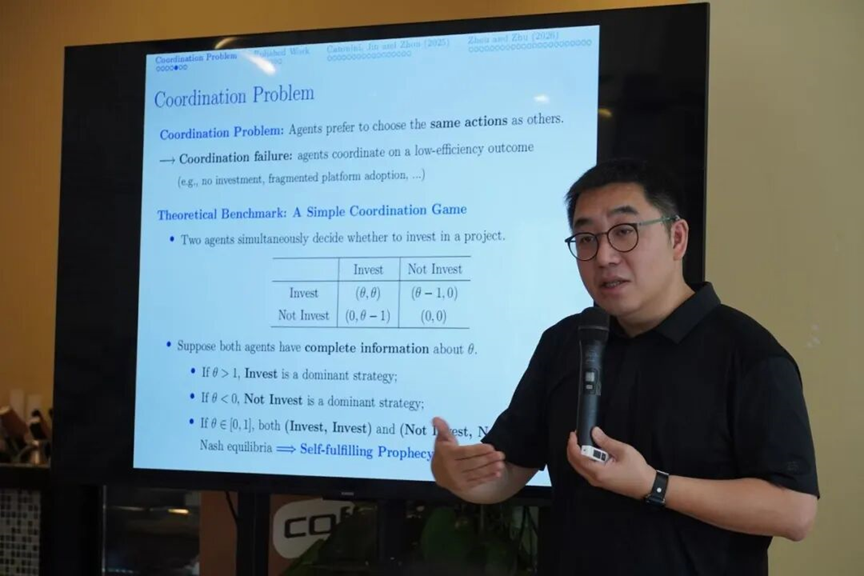
During the Q&A session, faculty and students engaged in in-depth exchanges covering coordination mechanism design and the implementation of industrial policies. This lecture delivered cutting-edge perspectives from information economics, facilitating academic exploration at the interdisciplinary intersection of humanities, social sciences, economics and finance at our university.