On June 24, Sun Xiaochun, Academician of the International Academy of the History of Science and Professor at the School of Humanities, the University of Chinese Academy of Sciences (UCAS), visited the Advanced Institute of Humanities and Social Sciences (AI-HSS). The two sides held in-depth discussions on core issues including the institute’s disciplinary development, talent recruitment and cultivation, the application for the discipline of history of science and technology, and future development plans. Leaders and faculty representatives of the institute attended the forum. Professor Shen Xiaorong extended a warm welcome to Professor Sun on behalf of the institute, while Professor Wan Xiaolong presented its development blueprint. Founded at the end of 2024, AI-HSS draws on the university’s strengths in electronic information disciplines and centers on four interdisciplinary research areas: ethics and philosophy of science and technology, cognitive linguistics and language intelligence, mathematical and quantitative economics, as well as technological innovation and social transformation, with initial fruitful outcomes achieved since its establishment.
During the discussion session, both sides exchanged views on disciplinary development, talent recruitment and cultivation, and international advancement. In terms of disciplinary construction, they talked about the evolution and current status of philosophy and history of science and technology, aiming to enrich the institute’s disciplinary ecosystem. For talent attraction and training, they proposed assembling research teams through major research projects and setting up a special fund for liberal arts development to boost competitiveness in recruiting scholars. On the international development, they suggested deepening cooperation with the International Council for Philosophy and Human Sciences, holding regular high-end academic forums to rapidly raise the international standing of relevant disciplines.
AI-HSS will continue to advance its layout of interdisciplinary research and the development of its talent pool, accelerating the construction of a high-level research platform for humanities and social sciences with distinctive characteristics. On June 23, Professor Sun delivered an academic lecture themed The Scientific Revolution and the Modern Transformation of Chinese Civilization as the guest speaker of the 33rd "Humanities × Technology" Thinkers’ Forum, with Professor Wan moderating the event.
Starting with landmark 20th-century scientific breakthroughs such as quantum mechanics and relativity, Professor Sun systematically sorted out the intertwined relationship between a century of scientific transformations and China’s modernization drive. He pointed out that though China missed out on the first Scientific Revolution, it rapidly integrated into the mainstream of global science in the 20th century, as evidenced by the accomplishments of scientists including Yang Chen-Ning. Addressing the Needham Question, Professor Sun argued that this inquiry carries an implicit Western-centric perspective, and scholars today ought to pay more attention to the contributions Chinese civilization has made to global science. Drawing examples such as ancient qi-measuring astronomical observations and calendrical mathematical modelling, he explored the inherent resonances between traditional Chinese modes of thinking and modern scientific methodologies, advocating for uncovering the scientific underpinnings of traditional culture through critical inheritance.
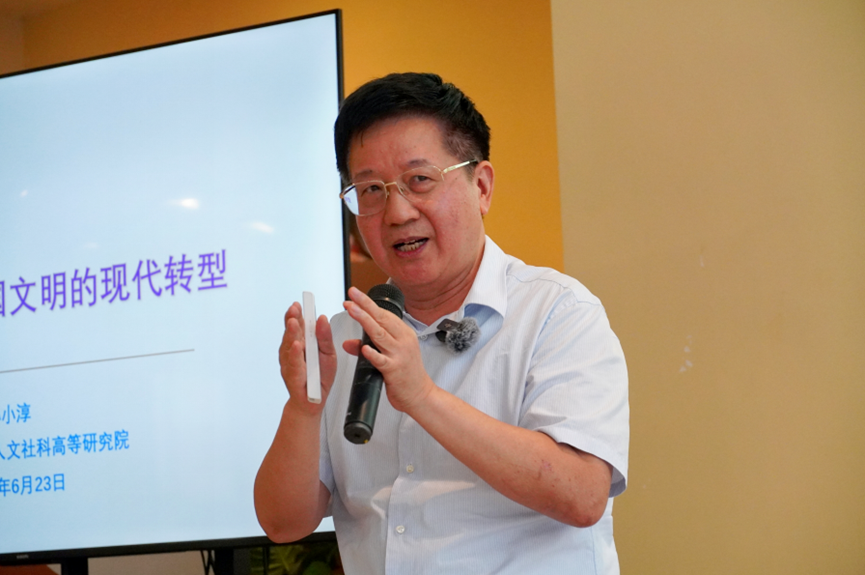
During the Q&A session, faculty and students actively raised questions covering a wide range of topics. On the positioning of science popularization, Professor Sun stated that historians of science and natural scientists take different approaches to outreach work: the former focus more on unfolding the evolutionary context and diverse possibilities of scientific ideas, rather than merely imparting established conclusions. As he put it, “The essence of science can only be found by delving into its history.” Regarding the philosophical relationship between materialism and quantum mechanics, he suggested moving beyond simplistic, labelled oppositions from an epistemological standpoint to address contemporary issues with an open mindset. In addition, Professor Sun shared unique insights on primary and secondary school science education, scientific aesthetics, and the cultivation of intuitive thinking. He encouraged young scholars to break disciplinary boundaries and broaden their horizons through the integration of humanities and sciences.