On June 25, Peng Peng, Deputy Director of the Institute for the History of Science and Technology at Shanxi University, visited the Advanced Institute of Humanities and Social Sciences (AI-HSS). The two parties held in-depth discussions on interdisciplinary development, talent exchange and academic cooperation, academic ecosystem construction and long-term development planning. Leaders and faculty representatives of the institute attended the forum. Professor Shen Xiaorong extended a warm welcome to Prof. Peng Peng on behalf of AI-HSS, and introduced the institute’s positioning, disciplinary progress and academic research landscape. Founded at the end of 2024, AI-HSS leverages the university’s strengths in electronic information disciplines to fully build an international cutting-edge research platform, with steady progress achieved across all development initiatives.
The two sides conducted in-depth discussions on disciplinary development, with particular focus on the developmental roadmap for the history of science and technology discipline. Regarding faculty development, they agreed to prioritize attracting and cultivating high-end core researchers and scale up recruitment of leading scholars from both domestic and international circles. In terms of resource support, they planned to diversify funding sources and launch a portfolio of branded academic initiatives, including regular lecture series, international conferences and local think tank programs centered on the history of science and technology, so as to nurture a self-sustaining academic ecosystem. Following the meeting, Prof. Peng visited the Electronic Science and Technology Museum to draw practical insights for future disciplinary construction.
On the same day, Prof. Peng delivered a special lecture titled Physics and the Emergence of Intelligence as the guest speaker of the 34th “Humanities × Technology” Thinkers’ Forum.
Prof. Peng centered his talk on the emergence of complex systems, distinguishing the theoretical divide between reductionism and emergentism, and tracing the evolution of the concept from philosophical speculation to condensed matter physics. He illustrated emergent phenomena across interdisciplinary fields with multiple examples including superconductivity. He elaborated on the internal logic behind neural networks acquiring novel capabilities once they cross a critical scale threshold, addressed practical challenges such as model black boxes and AI alignment, and prospected the application potential of quantum simulation technologies in resolving intractable problems of complex systems.
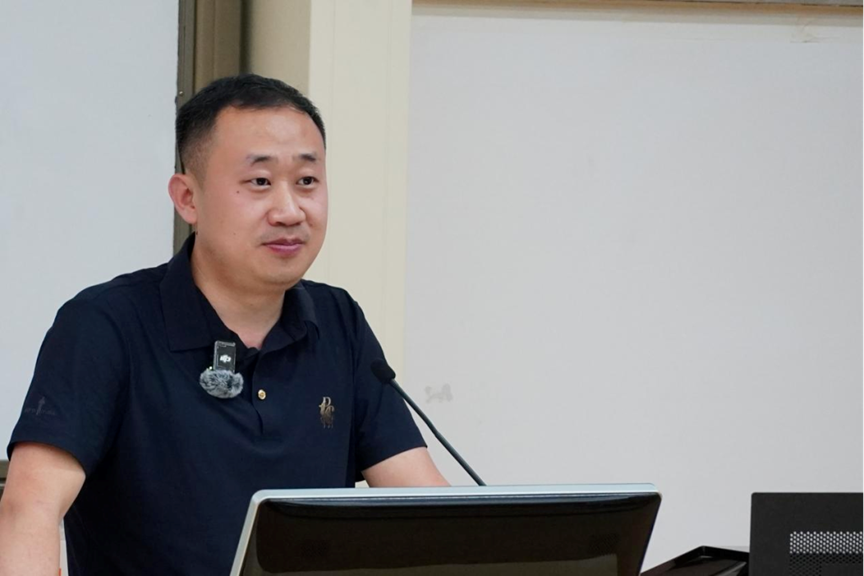
During the Q&A session, faculty and students present actively raised questions concerning the interpretability of large language models and interdisciplinary research pathways bridging arts and sciences. This lecture showcased the institute’s distinctive academic feature of integrating liberal arts and sciences, broadened the research horizons of participants, and boosted academic exploration in the fields of philosophy of science and intelligent science at our university.