On June 30, Professor Paolo Granata from the University of Toronto delivered a lecture entitled AI and the Future of Knowledge at the 35th "Humanities × Technology" Thinkers Forum hosted by the Advanced Institute of Humanities and Social Sciences (AI-HSS), with Nicola Liberati, Distinguished Research Fellow of the Institute, serving as the moderator of the event. Dr. Liberati extended a warm welcome and sincere appreciation for Professor Granata’s participation, and briefly introduced his major research areas and academic achievements. Professor Granata has long engaged in interdisciplinary research integrating artificial intelligence, philosophy and media ecology. His work focuses on the profound impacts of intelligent technologies on human cognitive frameworks, information communication mechanisms and humanistic value systems, combining theoretical insights with practical concerns regarding society and technology.
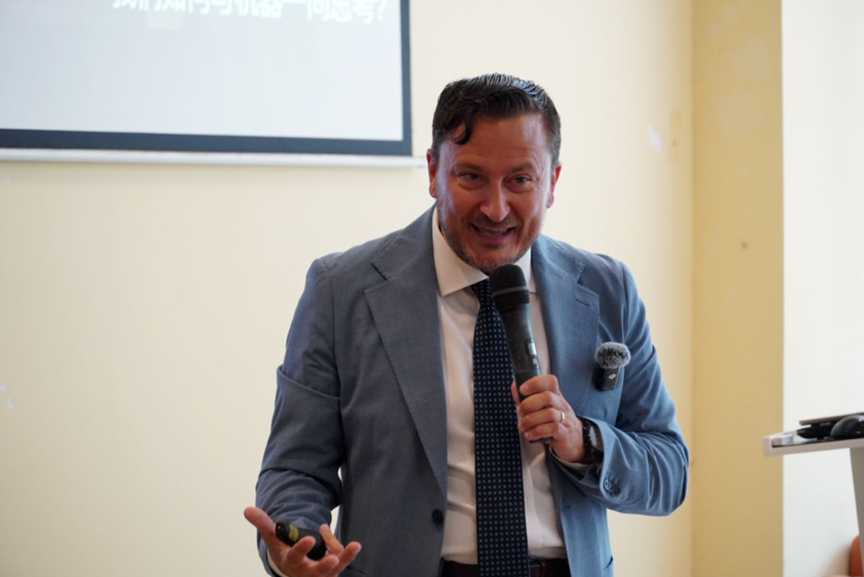
Starting with the historical evolution of universities and knowledge dissemination, Professor Granata reviewed how writing, the printing press and the modern university system have shaped humanity’s modes of knowledge production. He pointed out that printed books once served as a crucial interface of the modern knowledge system, fueling the development of scientific communities, peer review and contemporary academic institutions. Today, however, artificial intelligence is far more than a mere technical tool; it is evolving into a novel "cognitive environment". In this sense, humanity is transitioning from the "Gutenberg Galaxy" to the "Turing Galaxy". AI is redrawing the map of knowledge and transforming how humans comprehend, generate and disseminate knowledge. Professor Granata elaborated on the concept of "generative knowledge". He argued that the disruption brought by generative AI lies not merely in machines’ capacity to produce texts, images and answers, but in the unprecedented opportunity for humans to engage in linguistic interaction with non-human entities. Though AI does not necessarily "think" in human ways, it can accomplish numerous tasks that once relied exclusively on human intelligence, compelling us to rethink the interrelations among intelligence, language and knowledge.
During the Q&A session, the audience exchanged ideas with Professor Granata on topics including how adolescents should engage with artificial intelligence, the responsibilities of AI developers, and whether technological outsourcing impairs human cognitive capacities. The dialogue sparked profound reflections on artificial intelligence, knowledge production and humanity’s future.